Alternative Fuels Like Propane and Biofuels Have the Same Tailpipe Emissions as Diesel of Certain Pollutants. Electric School Buses Have None.
As more school districts are looking to phase out older diesel-burning buses, models beyond electric school buses – like alternative fuels – are getting attention. Here are the facts.

Key Takeaways:
- Tailpipe exhaust from school buses includes pollutants that are dangerous to the health of students, drivers and community members.
- Every type of alternative fuel for use in school buses on the market today has tailpipe emissions that are at least as bad as diesel for one or more category of pollutant.
- Electric school buses are the only type of school bus on the market that has zero tailpipe emissions.
- Alternative fuels are often hard to access or not available. Whereas electricity is supplied in every corner of the country, there are only five publicly accessible fueling stations with renewable diesel outside of the West Coast.
Today, diesel-burning school buses comprise the vast majority of school buses on the road. But increasingly, that’s beginning to change. There are now more options available, including electric school buses and “alternative fuel” school buses.
Alternative fuels include hydrogen, natural gas, propane, biodiesel and renewable diesel. One simple fact is true: Every type of alternative fuel for use in school buses on the market today has tailpipe emissions that are at least as bad as diesel for one or more category of pollutant.
Here’s how it breaks down.

Alternative fuels can fall into a few different categories.
- First, there are fuels that require a new type of school bus. That includes propane and renewable propane.
- Second, there are alternative fuels that work in existing diesel or gasoline buses. Those include biodiesel, renewable diesel and E85 gasoline.
- Last, there are fuels that don’t work with any school bus on the market today. These include compressed natural gas (CNG), liquified natural gas (LNG), renewable natural gas (RNG) and hydrogen.
Tailpipe exhaust pollution released by diesel-burning buses—and many alternative fuel types—is bad for the health of people of all ages. Burning diesel fuel and some types of alternative fuel releases air pollution like nitric oxide (NOx), particulate matter (PM) and volatile organic compounds (VOCs). All three of these types of air pollution can cause health issues ranging from eye irritation, nausea and breathing difficulties to asthma, respiratory conditions and heart conditions.
If we just look at the fuels that work with diesel or other school buses on the market, the emissions data is bleak:
- Biodiesel and renewable diesel cause about the same tailpipe emissions as diesel-burning buses for most pollutants, with the only improvement being on sulfur oxide (SOx).
- Propane, renewable propane and E85 buses have higher emissions of VOCs and carbon monoxide (CO), and similar levels of PM as diesel buses.
Tailpipe exhaust pollution released by diesel-burning buses—and many alternative fuel types—is bad for the health of people of all ages.
And to make matters more complicated, alternative fuels are often hard to access or not available. Whereas electricity is supplied in every corner of the country, there are only five publicly accessible fueling stations with renewable diesel outside of the West Coast. And with no manufacturers producing CNG, LNG or hydrogen school buses, these alternative fuels aren’t options for school bus operators either.
So why does all this matter? Because school districts want to transport students to and from school safely, conveniently, and without harmful tailpipe emissions. And alternative fuel school buses just can’t meet the moment.
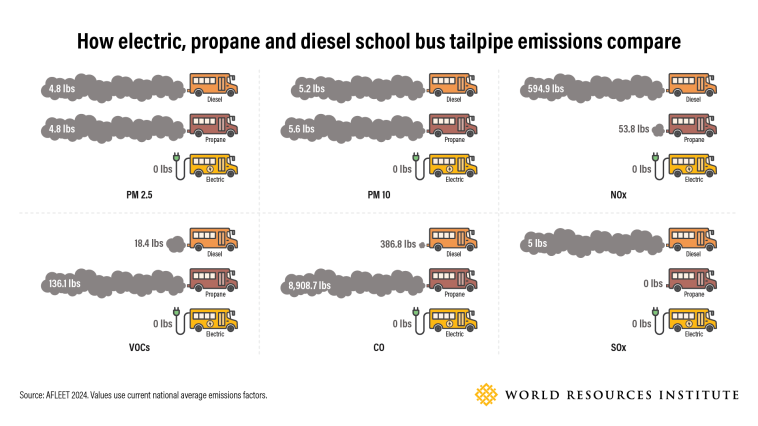
In communities that live near highways and are disproportionately exposed to vehicle-based air pollution, the type of fuel used for a school bus can make a difference in youth health and academic outcomes.
Due to nitrogen dioxide and particulate matter air pollution, pediatric asthma rates are 7.5 times higher in communities of color in the U.S. and premature mortality rates are 1.3 times higher than in mostly white communities. Not only is the air quality worse and more dangerous, but these students are more likely to rely on the bus for transportation to school.
Electric school buses have no tailpipe emissions, which eliminates these issues from school buses altogether.
School districts want to transport students to and from school safely, conveniently, and without harmful tailpipe emissions. And alternative fuel school buses just can’t meet the moment.
When accounting for well-to-wheel emissions—or the tailpipe emissions plus all the pollution created when generating or transporting fuel or feedstock like diesel, electricity, propane or vegetable oil for biodiesel—electric school buses still produce the lowest emissions of NOx, CO and VOC, with similar PM levels to diesel-burning buses.
Moreover, greenhouse gases released from diesel- and gas-burning school buses, like carbon dioxide (CO2) and methane (CH2), trap heat in the atmosphere and contribute to the rising temperatures associated with climate change, leading to extreme and dangerous weather like droughts, heat waves, and severe storms and flooding.
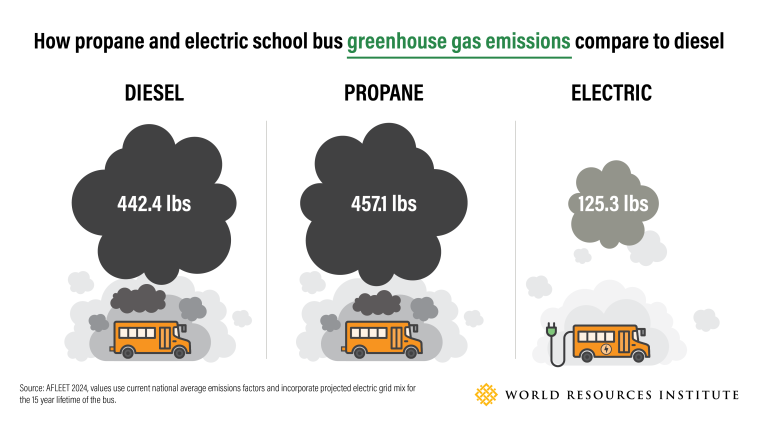
The United States has half a million school buses, and their fueling impacts climate pollution. Electric school buses produce the lowest greenhouse gas emissions across the full fuel lifecycle—even accounting for emissions from generating the electricity that powers the buses. Those emissions are expected to decrease even further as the transition to renewable energy progresses.
No matter how you slice it—whether looking at tailpipe emissions, well-to-wheels emissions, fuel access, bus availability, or climate impact—it’s clear that electric school buses come out ahead of alternative fuel school buses.